
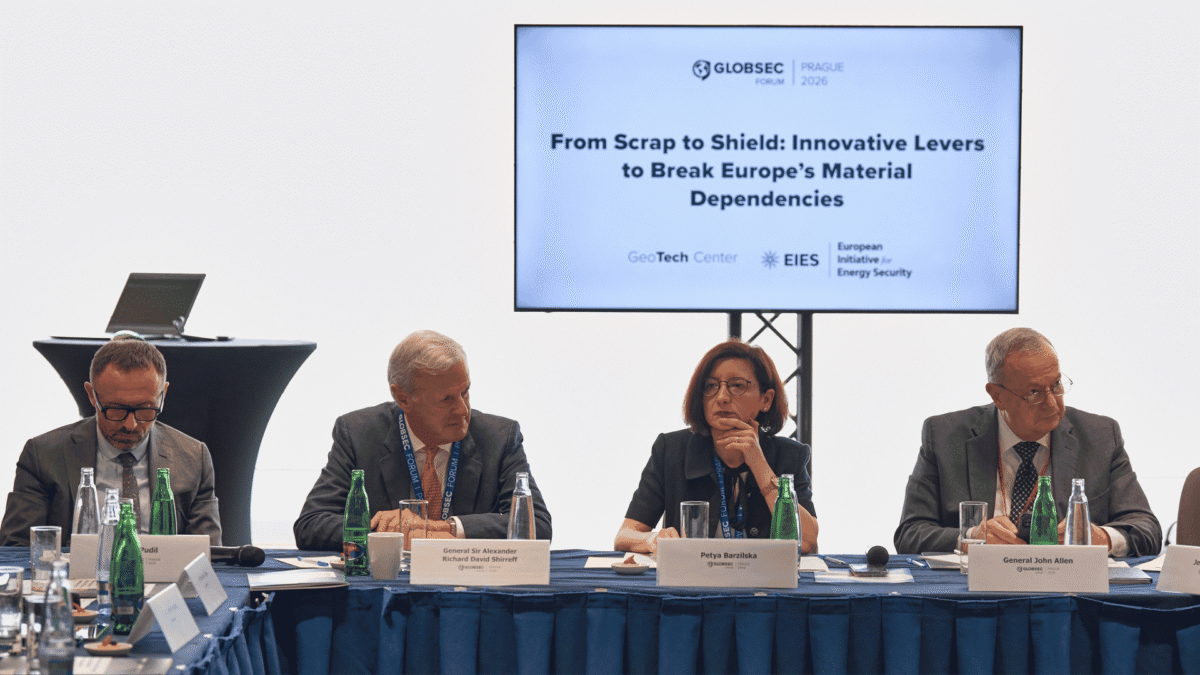
As Europe faces a more contested geopolitical environment, critical raw materials are increasingly understood not only as an industrial issue, but as a core security concern. Defence systems, clean technologies, batteries, electronics and advanced manufacturing all depend on materials whose supply chains remain vulnerable to external pressure, market manipulation and geopolitical disruption.
This roundtable explored how Europe can reduce strategic dependencies by strengthening recycling, processing, substitution, stockpiling and circular economy solutions. Participants emphasized that recycling alone will not solve Europe’s critical raw materials challenge, but that circularity can become a key security tool if combined with investment, innovation, procurement reform, and stronger industrial capacity.
Key takeaways:
Critical Raw Materials Are a Security Issue
- Participants stressed that critical raw materials are not merely a supply-chain concern, but an upstream choke point for Europe’s defence industrial base.
- The discussion highlighted that material security is directly linked to Europe’s ability to deter conflict, sustain defence production, and reduce vulnerability to external coercion.
- Several speakers underlined that China has treated raw materials as strategic leverage across the full value chain, from extraction and processing to refining and manufacturing know-how.
Circularity Is Necessary, but Not Sufficient
- Recycling was described as one of the most immediate levers available to Europe, but not a standalone solution.
- Participants agreed that Europe will not “mine its way out” or “recycle its way out” of dependency; the strategic answer is to combine recycling, primary supply, refining, substitution, tailings recovery and stockpiling.
- Circularity should therefore be treated as part of a broader security and industrial resilience strategy.
Cycles Europe Must Keep Strategic Materials in Europe
- Valuable materials should not disappear through landfill, low-quality treatment, or uncontrolled exports.
- Better collection, sorting and treatment of strategic waste streams were identified as essential priorities.
- Participants emphasized the need to build a stronger European market for secondary raw materials and make it easier for these materials to circulate within Europe.
Processing and Refining Are Major Bottlenecks
- Several speakers warned that securing mining assets alone is insufficient if processing and refining still take place outside Europe.
- Europe needs new refining capacity, cleaner processing technologies and lower energy costs to make domestic industrial capacity viable.
- Without investment in processing, Europe risks remaining dependent even when it has access
- to raw materials.
Investment Requires Demand Signals
- Participants argued that private capital will not flow into CRM recycling and processing without a clear business case.
- Public procurement, demand-side commitments, price stability mechanisms and de-risking instruments were discussed as ways to create investor confidence.
- Defence procurement could play a particularly important role in creating stable demand for recycled and secure materials.
Innovation Must Move from Lab to Scale
- Europe has a strong research base, but innovation often stalls between laboratory
- development and industrial deployment.
- Promising areas include rare-earth-free magnets, sodium-ion batteries, advanced recycling chemistries, AI-enabled recovery from tailings, and material substitution.
- The core challenge is not only invention, but industrial follow-through and scale.
Proposed Solutions
- Treat defence-critical materials and recycling capacity as strategic security infrastructure.
- Fast-track permitting for CRM recycling, refining, magnet recovery, battery black mass treatment, electronics recycling and tailings reprocessing.
- Map defence material flows to identify where critical materials can be recovered and reused.
- Strengthen European processes